
The Quick Facts
- Growth portfolios (70% global equity / 30% U.S. Aggregate bond) gained 2.0% in August and are now up 9.9% year-to-date and 16.2% over the past twelve months.[1]
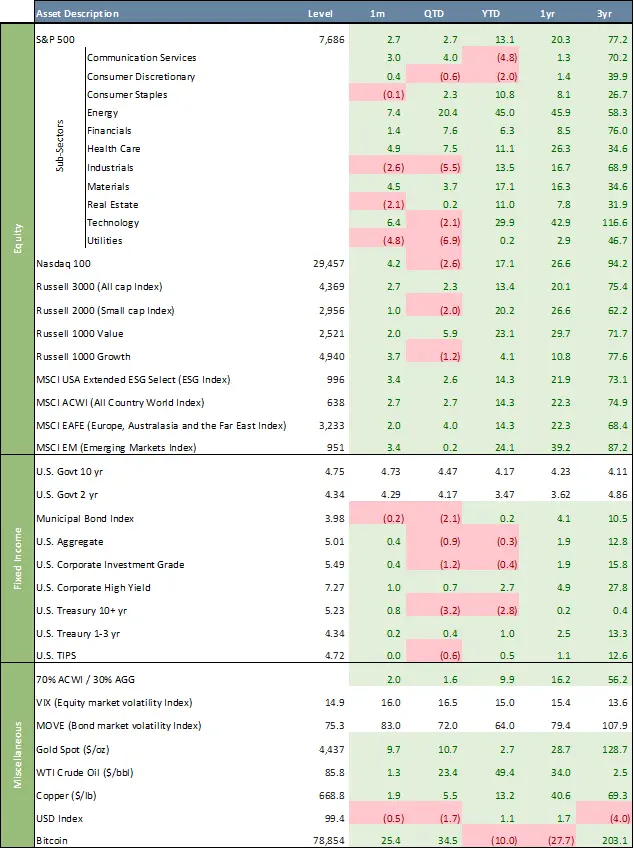
- U.S. equities advanced broadly. The S&P 500 gained 2.7%, while the Nasdaq 100 rose 4.2% and the Russell 1000 Growth Index rebounded 3.7%.
- Second quarter earnings were exceptional. S&P 500 earnings grew nearly 38% year over year, the strongest growth since 2021, and approximately 86% of companies exceeded analyst expectations.
- Sector leadership broadened. Energy gained 7.4%, Technology rose 6.4%, and Health Care advanced 4.9%, while Utilities declined 4.8% and Industrials fell 2.6%.
- Emerging markets gained 3.4% and are now up 24.1% year-to-date. The MSCI Europe, Australasia and Far East Index gained 2.0%, bringing its year-to-date return to 14.3%.
- Fixed income posted modest gains despite slightly higher Treasury yields. At Jackson Hole, Chair Kevin Warsh emphasized that inflation remains too high and restoring price stability remains the Federal Reserve’s priority.
August Asset Class Performance
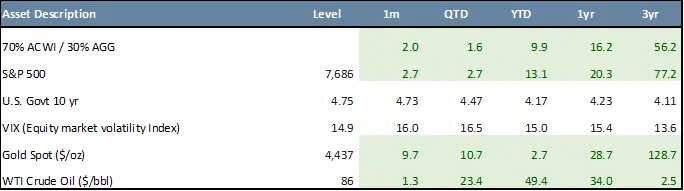
Markets regained momentum in August despite renewed geopolitical volatility at month-end. Strength across U.S. and emerging-market equities, a rebound in growth stocks, and modest gains across most fixed-income markets supported diversified portfolios. A traditional 70% global equity / 30% U.S. Aggregate bond growth portfolio gained 2.0% during the month and is now up 9.9% year-to-date and 16.2% over the past twelve months. Several different sources of return contributed at the same time, allowing diversified portfolios to benefit without depending on one specific market outcome.
Earnings were the most important support. S&P 500 companies delivered their strongest year-over-year earnings growth since 2021, with the blended growth rate reaching nearly 38%. Approximately 86% of companies exceeded analyst expectations, well above historical averages. Strong earnings provide a legitimate foundation for the market, but they do not make valuations irrelevant. Elevated expectations increase sensitivity to earnings disappointments.
U.S. equities advanced broadly. The S&P 500 gained 2.7% and is now up 13.1% year-to-date. Growth stocks rebounded from their July selloff, with the Nasdaq 100 gaining 4.2% and the Russell 1000 Growth Index advancing 3.7%. The Russell 1000 Value Index gained 2.0% and remains the stronger style year-to-date, returning 23.1% compared with 4.1% for growth. Markets rarely move in a straight line, and leadership can change quickly when valuations, interest rates, or earnings expectations shift. We do not believe investors should chase the growth rebound or abandon value after its strong year-to-date performance. Maintaining exposure to both styles remains more sensible than predicting which one will lead next.
Sector performance was mixed. Energy gained 7.4%, extending its year-to-date return to 45.0%, while Technology advanced 6.4% and is now up 29.9% for the year. Health Care and Materials gained 4.9% and 4.5%, respectively. Utilities declined 4.8%, Industrials fell 2.6%, and Real Estate lost 2.1%. This dispersion shows how a positive headline return can hide very different outcomes beneath the surface. Our preference remains to use diversification as a risk-management tool rather than making large tactical allocations based on recent performance.
International markets also advanced. Emerging markets led with a 3.4% gain and are now up 24.1% year-to-date. The MSCI Europe, Australasia and Far East Index gained 2.0%, while the broader MSCI All Country World Index advanced 2.7%. Both indexes are up 14.3% year-to-date. The strong performance of emerging markets reinforces the value of maintaining exposure outside the United States. It does not change our view that U.S. equities should remain the core of most global equity allocations, but international exposure provides access to different economic cycles, valuations, currencies, and sources of return.
Fixed income generated modest gains even as Treasury yields moved slightly higher. The 10-year Treasury yield increased from 4.73% to 4.75%, while the 2-year yield rose from 4.29% to 4.34%. The Bloomberg U.S. Aggregate Bond Index and investment-grade corporate bonds each gained 0.4%, while high-yield bonds advanced 1.0%. Municipal bonds declined 0.2%. Current yields offer a much better starting point for future bond returns than they did when interest rates were near zero. Bonds continue to play an important role in income generation, liquidity management, capital preservation, and diversification.
The Federal Reserve did not meet in August, so the federal funds rate remained within its 3.50% to 3.75% range. At Jackson Hole, Chair Kevin Warsh emphasized the economy’s resilience but reiterated that inflation remains too high. With twelve-month personal consumption expenditures inflation at 3.7%, restoring price stability remains the Federal Reserve’s predominant focus. Our portfolios are not built around predicting the next interest-rate decision. We prefer to maintain balanced duration exposure, collect available income, and avoid making portfolio outcomes solely dependent on correctly forecasting the Federal Reserve.
Commodities continued to benefit from geopolitical uncertainty. West Texas Intermediate crude oil gained 1.3% in August to approximately $85.80 per barrel and is now up 49.4% year-to-date. Gold rose 9.7% to approximately $4,437 per ounce, bringing its year-to-date return to 2.7%, while copper gained 1.9% and is up 13.2% for the year. We view commodities and gold as potential diversifiers, not replacements for productive assets such as equities and income-generating bonds. The U.S. Dollar Index declined 0.5% but remains up 1.1% year-to-date. Bitcoin rebounded 25.4%, although it remains down 10.0% in 2026, while equity and bond market volatility declined.
August demonstrated that strong earnings can continue to support equity markets despite elevated interest rates and geopolitical uncertainty. Our point of view remains straightforward. Investors should focus on maintaining appropriate policy allocations, managing liquidity, diversifying risk, and rebalancing when markets create opportunities. The goal is to construct portfolios capable of compounding through different market environments without requiring perfect forecasts or perfect timing.
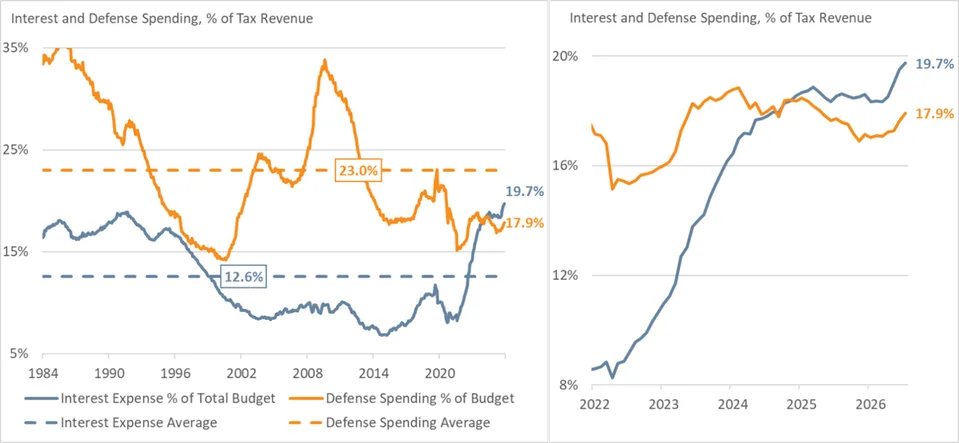
Chart of the Month – Interest Expense and Defense Spending as a % of Tax Revenue
One of the clearest signs of mounting fiscal pressure is the rapid increase in the cost of servicing the federal debt. Interest expense now consumes 19.7% of federal tax revenue, more than double its level in 2022. It has also surpassed defense spending, which currently represents 17.9% of tax revenue. Historically, the opposite has been true. Since 1984, interest expense has averaged 12.6%, compared with 23.0% for defense.
This increase is the result of two forces working together: a much larger federal debt and higher borrowing costs. The government is gradually refinancing debt issued when interest rates were close to historic lows. Even if the Federal Reserve continues to reduce short-term rates, the average interest rate paid on the federal debt could keep rising as older securities mature and are replaced with more expensive ones.
The budget tradeoff is becoming harder to avoid. Together, interest and defense spending now consume nearly 38 cents of every federal tax dollar. Geopolitical tensions make large defense cuts unlikely, while interest payments cannot simply be negotiated away. Congress can debate spending priorities, but bondholders still get paid. That leaves less money for infrastructure, healthcare, education, and future economic support.
This does not mean that a U.S. debt crisis is imminent. The country still benefits from the world’s deepest capital markets and the dollar’s reserve currency status. However, large deficits and heavy Treasury issuance could keep longer-term interest rates higher and create more market volatility. The answer is not panic, but realism. Investors should not build portfolios around the assumption that interest rates will return to zero or that the government will always have unlimited room to support the economy.
Quote of the Month
“Blessed are the young, for they shall inherit the national debt.” – Herbert Hoover (31st president of the U.S. serving from 1929 to 1933).
Major Asset Class Dashboard
Curated by Julien Frazzo, Deputy Chief Investment Officer, and Michael G. Dow, CAIA, CFA, Chief Investment Officer.
1 The 70/30 balanced portfolio is a hypothetical index blend and does not represent an actual Beacon Pointe portfolio. Indexes are unmanaged, cannot be invested in directly, and do not reflect fees, expenses, or taxes.
Related Links
Beacon ‘Pointe of View’ – A Market Update August 2026
Macro & Markets: August 2026 – An Update from Beacon Pointe CIO
Important Disclosure: The information contained in this article is for general informational purposes only. Opinions referenced are as of the publication date and may be modified due to changes in the market or economic conditions and may not necessarily come to pass. Forward-looking statements cannot be guaranteed. Past performance is not a guarantee of future results. Beacon Pointe has exercised all reasonable professional care in preparing this information. The information has been obtained from sources we believe to be reliable; however, Beacon Pointe has not independently verified or attested to the accuracy or authenticity of the information. The discussions, outlook, and viewpoints featured are not intended to be investment advice and do not consider specific investment objectives or risk tolerance you may have. All investments involve risks, including the loss of principal. Consult your financial professional for guidance specific to your circumstances. This document has been prepared with the assistance of ChatGPT Enterprise, an AI-powered tool designed to enhance productivity and provide support in drafting, editing, and organizing content. ChatGPT Enterprise leverages advanced AI models to generate text based on user input. Although ChatGPT Enterprise generates original content based on user input, there is a risk that the generated text may inadvertently resemble existing works that may not be properly cited. AI‑assisted content is reviewed by Beacon Pointe personnel for accuracy, completeness, and compliance.