

The Quick Facts
- October rewarded diversification. Value stocks gained 4.4%, while growth stocks fell 6.1%. Defensive sectors and bonds also advanced.
- Growth portfolios (70% Global Equity / 30% U.S. Aggregate bond) declined 0.4% in October and are up 7.7% year-to-date and 8.6% over the past twelve months.
- The S&P 500 declined 0.9%, the Nasdaq 100 fell 6.6%, and the Russell 2000 gained 0.6%.
- The Federal Reserve held rates at 3.75% to 4.00% as inflation remained elevated.
- The 10-year Treasury yield fell from 5.28% to 4.93%. The U.S. Aggregate Bond Index gained 2.4%, while municipal bonds advanced 3.9%.
October Asset Class Performance
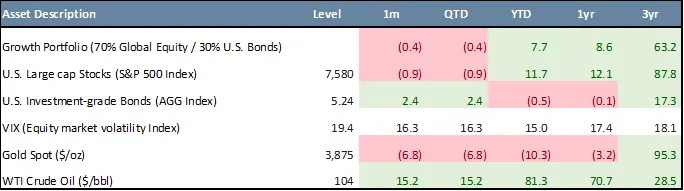
October brought a sharp rotation in market leadership. Value stocks, defensive sectors, and Energy advanced, while Technology and Communication Services declined. Bonds recovered as Treasury yields fell, cushioning losses in global equities. A traditional 70% Global Equity / 30% U.S. Aggregate bond portfolio declined 0.4% during the month and is up 7.7% year-to-date and 8.6% over the past twelve months.
The economy remained resilient, with third-quarter growth accelerating to an annualized 3.4%, although hiring remained subdued. Inflation continued to challenge policymakers, with consumer prices rising 3.7% over the previous year. The Federal Reserve held its policy rate at 3.75% to 4.00%, while leaving open the possibility of further increases.
The S&P 500 declined 0.9% but remains up 11.7% year-to-date. Beneath that modest monthly decline, performance varied considerably: value stocks gained 4.4%, while growth stocks fell 6.1%. Nine of the eleven S&P 500 sectors advanced, led by Energy. International developed stocks declined 0.7%, while emerging markets fell 8.0%. Corporate earnings continued to grow strongly, but disappointing results from several major technology companies raised questions about the returns on artificial intelligence investment.
Bonds provided some relief. The 10-year Treasury yield fell from 5.28% to 4.93%, helping the U.S. Aggregate Bond Index gain 2.4%, and municipal bonds advance 3.9%. Meanwhile, oil rose 15.2% to $104 per barrel as Middle East tensions heightened supply concerns. Sustained energy-price increases remain a risk to inflation and household purchasing power.
October reinforced the benefits of diversification. Gains in value stocks and bonds helped offset weakness in growth stocks and emerging markets. Looking ahead, energy prices, interest rates, and corporate earnings remain central to the outlook.
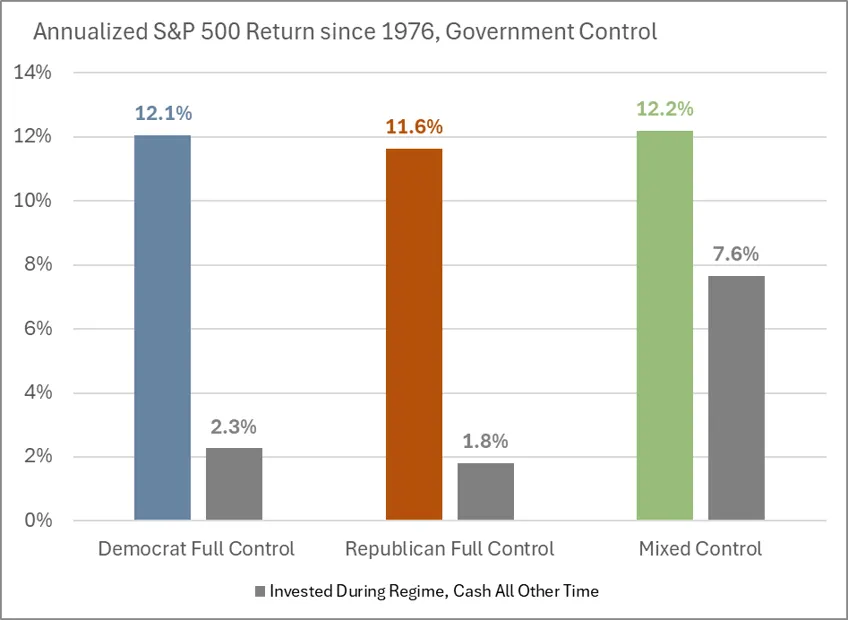
Chart of the Month – Annualized S&P 500 Return since 1976, Government Control
Politics can influence policy, but party control has been a poor guide to market timing. Since 1976, annualized S&P 500 returns were remarkably similar under full Democratic control, full Republican control, and mixed government: 12.1%, 11.6%, and 12.2%, respectively.
Investors who held stocks only during one of these government configurations and stayed in cash otherwise earned substantially less: 2.3%, 1.8%, and 7.6%, respectively. Staying invested allowed investors to participate in market growth across changing administrations.
Election outcomes can feel personal, but we believe portfolio decisions should reflect financial goals, time horizon, and tolerance for risk. Markets generally respond to policies, interest rates, and corporate earnings. Whether our preferred team wins or loses is a weak basis for changing a long-term investment plan.
Quote of the Month
“You do not want to have a political view in investing.”-Warren Buffett.
Curated by Julien Frazzo, Deputy Chief Investment Officer, and Michael G. Dow, CAIA, CFA, Chief Investment Officer.
Related Links
Beacon ‘Pointe of View’ – A Market Update October 2026
Important Disclosure: The information contained in this article is for general informational purposes only. Opinions referenced are as of the publication date and may be modified due to changes in the market or economic conditions and may not necessarily come to pass. Forward-looking statements cannot be guaranteed. Past performance is not a guarantee of future results. Beacon Pointe has exercised all reasonable professional care in preparing this information. The information has been obtained from sources we believe to be reliable; however, Beacon Pointe has not independently verified or attested to the accuracy or authenticity of the information. The discussions, outlook, and viewpoints featured are not intended to be investment advice and do not consider specific investment objectives or risk tolerance you may have. All investments involve risks, including the loss of principal. Consult your financial professional for guidance specific to your circumstances. This document has been prepared with the assistance of ChatGPT Enterprise, an AI-powered tool designed to enhance productivity and provide support in drafting, editing, and organizing content. ChatGPT Enterprise leverages advanced AI models to generate text based on user input. Although ChatGPT Enterprise generates original content based on user input, there is a risk that the generated text may inadvertently resemble existing works that may not be properly cited. AI‑assisted content is reviewed by Beacon Pointe personnel for accuracy, completeness, and compliance.