

The Quick Facts
- We continue to favor diversification and disciplined rebalancing rather than chasing recent winners or abandoning bonds after the selloff.
- A 70% global stock / 30% U.S. bond portfolio declined 1.6% in September, gained 0.1% for the quarter, and is up 8.2% year-to-date.
- U.S. large-company stocks were resilient, but small companies struggled as borrowing costs rose.
- The Federal Reserve raised interest rates by 0.25%, its first increase since July 2023.
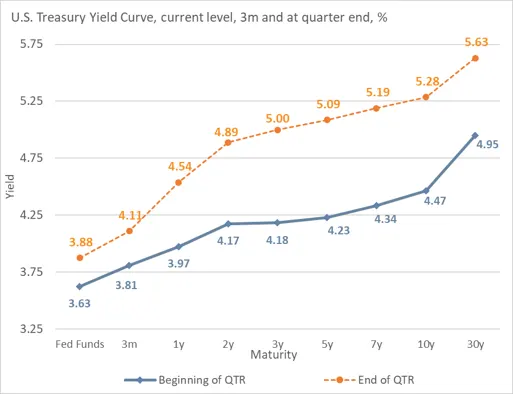
- The 10-year Treasury yield rose sharply to 5.28%, contributing to the worst month for government bonds in four years.
- Although falling bond prices hurt recent returns, higher yields now offer investors better income and future return potential.
September Asset Class Performance
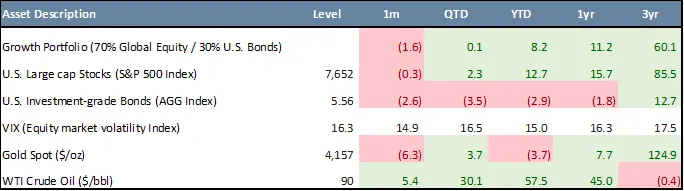
Markets ended the third quarter on an uneven note as rising interest rates weighed on bonds, small-company stocks, and other rate-sensitive investments. A traditional portfolio of 70% global stocks and 30% U.S. bonds declined 1.6% in September, gained 0.1% for the quarter, and is up 8.2% year-to-date.
U.S. large-company stocks held up relatively well. The S&P 500 declined 0.3% in September but gained 2.3% during the quarter and is up 12.7% this year. The technology-focused Nasdaq 100 gained 3.3% during the month and is up 21.0% year-to-date. Small-company stocks were more affected by higher borrowing costs, falling 5.3% in September and 7.2% during the quarter.
Market leadership remained mixed. Technology gained 5.1% in September, while Energy was the strongest sector during the quarter. Utilities, Industrials, Consumer Discretionary, and Real Estate struggled as interest rates rose. This wide range of results reinforces the value of owning different types of companies rather than trying to predict the next market leader.
International stocks weakened in September but remain positive for the year. Developed international markets are up 10.9% year-to-date, while emerging markets have gained 23.4%. International investments continue to provide exposure to different economies, currencies, and sources of return.
The Federal Reserve raised its policy rate by 0.25% in September, its first increase since July 2023. Bond yields rose sharply as investors became more concerned about inflation and the possibility that interest rates could remain elevated. The 10-year Treasury yield climbed to 5.28%, its largest quarterly increase since 1994.
The U.S. Aggregate Bond Index declined 2.6% in September and 3.5% during the quarter. Corporate and municipal bonds also fell. These losses were painful, but higher yields improve the outlook for bond income and future returns. Bonds continue to play an important role in providing income, liquidity, stability, and diversification.
Commodities delivered mixed results. Oil gained 30.1% during the quarter, while gold gained 3.7%. Bitcoin rose 42.6% but remains down 4.6% for the year.
The quarter showed that diversification does not protect every part of a portfolio at all times. When interest rates rise quickly, both stocks and bonds can decline together. Investors should remain focused on their long-term allocation, liquidity needs, and disciplined rebalancing rather than trying to forecast every change in rates or market leadership.
Chart of the Month – The U.S. Treasury Yield Curve Resets Higher
Interest rates rose across the Treasury market during the third quarter. The 2-year Treasury yield increased from 4.17% to 4.89%, while the 10-year yield climbed from 4.47% to 5.28%. The 30-year yield ended the quarter at 5.63%.
Higher rates create short-term losses because bond prices fall when yields rise. Longer-term bonds are generally more sensitive to these changes. Higher Treasury yields can also increase mortgage rates and business borrowing costs.
There is a positive side for long-term investors. New bonds can now be purchased at much higher yields, offering better income and return potential than when rates were near zero.
The message is not to abandon bonds after a difficult quarter. It is to recognize that the interest-rate environment has changed. Investors should remain diversified, manage maturity risk carefully, and avoid assuming that rates will quickly return to the unusually low levels of the past decade.
Quote of the Month
“Interest rates are to asset prices what gravity is to the apple.”-Warren Buffett.
Curated by Julien Frazzo, Deputy Chief Investment Officer, and Michael G. Dow, CAIA, CFA, Chief Investment Officer.
Related Links
Beacon ‘Pointe of View’ – A Market Update September 2026
Important Disclosure: The information contained in this article is for general informational purposes only. Opinions referenced are as of the publication date and may be modified due to changes in the market or economic conditions and may not necessarily come to pass. Forward-looking statements cannot be guaranteed. Past performance is not a guarantee of future results. Beacon Pointe has exercised all reasonable professional care in preparing this information. The information has been obtained from sources we believe to be reliable; however, Beacon Pointe has not independently verified or attested to the accuracy or authenticity of the information. The discussions, outlook, and viewpoints featured are not intended to be investment advice and do not consider specific investment objectives or risk tolerance you may have. All investments involve risks, including the loss of principal. Consult your financial professional for guidance specific to your circumstances. This document has been prepared with the assistance of ChatGPT Enterprise, an AI-powered tool designed to enhance productivity and provide support in drafting, editing, and organizing content. ChatGPT Enterprise leverages advanced AI models to generate text based on user input. Although ChatGPT Enterprise generates original content based on user input, there is a risk that the generated text may inadvertently resemble existing works that may not be properly cited. AI‑assisted content is reviewed by Beacon Pointe personnel for accuracy, completeness, and compliance.