
The Quick Facts
- A growth portfolio invested 70% in equities and 30% in fixed income declined -0.3% in July but remained up +7.7% year-to-date.
- Market leadership shifted from technology and growth stocks to value, energy, and financials.
- Treasury yields rose as bond prices declined, while the Fed kept interest rates unchanged.
- July’s calm headline returns masked a sharp rotation toward value, higher energy prices, and bond-market pressure, reinforcing the benefits of diversification.
Growth-oriented portfolios gave back a small portion of recent gains in July as weakness in technology and bonds offset strength in value stocks, energy, and commodities. A traditional portfolio of 70% global equities and 30% U.S. bonds declined 0.3% for the month but remained up 7.7% year-to-date and 16.3% over the past twelve months.1
Market leadership shifted sharply during the month. The S&P 500 was nearly flat, declining 0.1%, while the technology-heavy Nasdaq 100 fell 6.6%. Technology stocks declined 8.0% as investors became more cautious about high valuations and heavy spending related to artificial intelligence. Despite the pullback, the sector remained strongly positive over longer periods.
Value stocks performed much better than growth stocks. The Russell 1000 Value Index gained 3.8%, while the Russell 1000 Growth Index declined 4.8%. Energy rose 12.1%, supported by higher oil prices, and financial stocks gained 6.2%. Small-cap stocks declined 3.0% but remained up 19.0% for the year.
International developed markets outperformed U.S. stocks, with the MSCI EAFE Index gaining 2.0%. Emerging markets declined 3.1% but remained up 20.0% year-to-date. A weaker U.S. dollar provided some support to overseas investments.
Bonds declined as Treasury yields rose. The Bloomberg U.S. Aggregate Bond Index fell 1.3%, while longer-term Treasuries declined 4.0%. The 10-year Treasury yield ended July at 4.73%, up from 4.47% at the end of June.
The Federal Reserve kept interest rates unchanged at 3.50% to 3.75% for a fifth consecutive meeting. Officials remained concerned about inflation, particularly as higher energy prices added uncertainty. Markets are currently expecting approximately one to two quarter-point increases by year-end.
Commodities generally performed well. Oil rose nearly 22% to approximately $85 per barrel, reflecting renewed geopolitical concerns. Gold gained 1.0%, while copper rose 3.4%. Bitcoin increased 7.3% but remained sharply lower for the year.
Overall, July was a reminder that stable headline market returns can hide meaningful changes beneath the surface. Leadership shifted from growth toward value, energy prices rose, and higher interest rates weighed on bonds. Most major equity markets remained positive for the year, reinforcing the importance of staying diversified rather than reacting to short-term market moves.
June Asset Class Performance
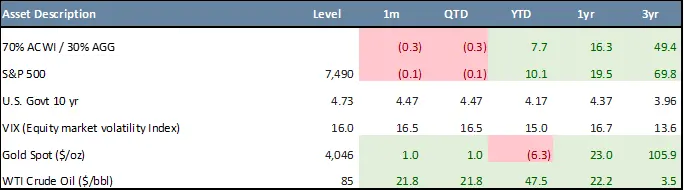
Chart of the Month – Contributors to Headline CPI Inflation
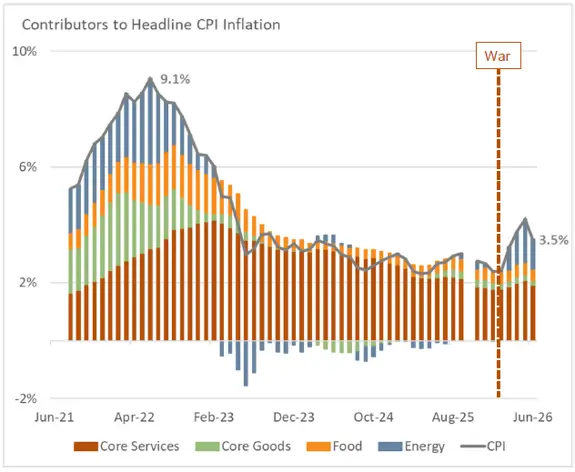
This month’s chart breaks headline Consumer Price Index (“CPI”) inflation into its major components—core services, core goods, food, and energy—to show where price pressures are coming from. During the 2021–2022 inflation surge, increases were broad-based, with supply-chain disruptions, rising food and energy costs, and stronger services inflation pushing headline CPI to a peak of 9.1% in June 2022.
Inflation later declined as supply chains normalized, goods prices stabilized, and energy costs eased. Core services, however, remained the largest and most persistent contributor. That progress was interrupted in the second quarter of 2026 by the closure of the Strait of Hormuz, which triggered a sharp global energy-price shock. As the chart shows, the resulting increase in energy costs pushed headline inflation to approximately 3.5% by June. The missing bars reflect a temporary lack of detailed inflation data during the government shutdown, when the agencies responsible for collecting and publishing the underlying CPI components were unable to operate normally.
The composition of the increase matters. Unlike the broad inflation surge of 2021 and 2022, the latest acceleration is concentrated primarily in energy, while core goods and food inflation remain relatively contained and services inflation continues to moderate. This suggests the increase may be less persistent, although prolonged energy disruption could eventually raise transportation, production, and distribution costs across the economy.
For the Federal Reserve, the key issue is whether the shock remains temporary or spreads into broader prices and inflation expectations. Policymakers may look through a one-time increase in energy costs, but a sustained pass-through into core inflation could delay rate cuts or require a more restrictive policy stance.
Quote of the Month
“It is not those who can inflict the most but those who can endure the most who will conquer.” – Terence MacSwiney
Curated by Julien Frazzo, Deputy Chief Investment Officer, and Michael G. Dow, CAIA, CFA, Chief Investment Officer.
1The 70/30 balanced portfolio is a hypothetical index blend and does not represent an actual Beacon Pointe portfolio. Indexes are unmanaged, cannot be invested in directly, and do not reflect fees, expenses, or taxes.
Related Links
Beacon ‘Pointe of View’ – A Market Update July 2026
Macro & Markets: August 2026 Registration – An Update from Beacon Pointe CIO
Important Disclosure: The information contained in this article is for general informational purposes only. Opinions referenced are as of the publication date and may be modified due to changes in the market or economic conditions and may not necessarily come to pass. Forward-looking statements cannot be guaranteed. Past performance is not a guarantee of future results. Beacon Pointe has exercised all reasonable professional care in preparing this information. The information has been obtained from sources we believe to be reliable; however, Beacon Pointe has not independently verified or attested to the accuracy or authenticity of the information. The discussions, outlook, and viewpoints featured are not intended to be investment advice and do not consider specific investment objectives or risk tolerance you may have. All investments involve risks, including the loss of principal. Consult your financial professional for guidance specific to your circumstances. This document has been prepared with the assistance of ChatGPT Enterprise, an AI-powered tool designed to enhance productivity and provide support in drafting, editing, and organizing content. ChatGPT Enterprise leverages advanced AI models to generate text based on user input. Although ChatGPT Enterprise generates original content based on user input, there is a risk that the generated text may inadvertently resemble existing works that may not be properly cited. AI‑assisted content is reviewed by Beacon Pointe personnel for accuracy, completeness, and compliance.