

“Investing is simple, but not easy” – Warren Buffett
August 2025
Authored by Julien Frazzo, Beacon Pointe Advisors Deputy Chief Investment Officer
“With close to three decades of experience navigating global markets, I have gained insights I wish I had known from the start. My journey began in London and spanned major financial centers worldwide — from Lehman Brothers’ trading floors to managing portfolios at Citadel and boutique hedge funds, and now as Deputy Chief Investment Officer at Beacon Pointe Advisors. Each step has deepened my understanding of investing, risk, and wealth creation.
With advanced degrees in finance and economics and experience across both U.S. and European markets, I bring a global perspective to investing. This combination of an academic foundation, cross-border exposure, and real-world application has given me a unique vantage point — and a set of lessons I now share with the hope of helping others navigate financial markets.
The Commonsense Guide to Investing is designed as a practical resource, covering a spectrum of financial topics — from foundational concepts to advanced strategies. Feel free to explore the sections that resonate most with your interests.” – Julien Frazzo
Key Takeaways:
- Investment returns are driven largely by asset allocation decisions rather than frequent trading.
- Clarity around investment terminology and avoiding unnecessary complexity can support decision‑making.
- Time in the market tends to influence long‑term outcomes more than attempts to time entry and exit.
- Different approaches, such as lump‑sum investing and dollar‑cost averaging, offer distinct trade‑offs.
- Risk and liquidity considerations are part of evaluating how investments align with goals and time horizons.
- Concepts like diversification and risk management are integral to constructing a balanced portfolio.
- Views on income, yield, and specific asset classes can differ based on market conditions and investor objectives.
- Passive investing strategies and broad market exposure are highlighted as consistent components of many investment frameworks.
* * *
Table of Contents
1.“Investing Is Simple, But Not Easy.”
2. Asset Allocation: The Real Driver of Returns
3. Do Not Get Lost in the Jargon and Overwhelmed by Acronyms
4. Time in the Market Beats Timing the Market
5. Lump-Sum Investing or Dollar-Cost Averaging?
6. Risk And Liquidity: Finding Your Balance
7. Managing Risk Starts With Knowledge
8. Volatility Is Your Friend
9. Risk, Reward, And Capital Structure
10. Diversification: The “Only Free Lunch”
11. Being Aligned With The Economy: An Indirect Hedge
12. The Income Illusion: Yield Is Not Always What It Seems
13. Dividend Stocks Are Not The Holy Grail
14. Market Signals Speak Louder Than Macro Data
15. Why We Closely Watch The Fed
16. Equity Valuations, Demystified
17. How Bonds Are Priced
18. Do You Really Need To Pick Stocks?
19. In Liquid Markets, Passive Strategies Often Prevail
20. U.S. Equities Exceptionalism: Still The World’s MVP
21. The Case For Alternative Investments
22. Cash: The Comforting Illusion
23. Do You Really Need Gold And Bitcoin?
24. How Should I Think About Currencies?
25. Going Short And Options Trading: Leave It To The Pros
26. Debt Done Right: A WACC-Based Approach To Personal Finance
27. The Case For Homeownership
28. Taxes: It Is Not What You Make — It Is What You Keep
29. DIY Investing? Why It Is Harder Than It Looks
30. Your Financial Plan: “The Closest Thing We Have To A Crystal Ball”
31. Benchmark Returns And Tracking Error Volatility: What You (Or Your Advisor) Must Know
32. The Institutional Approach To Investing And Managing Risk
33. Why Beacon Pointe? Our allWEALTH® Process To Serve You
34. Conclusion: My Survival Guide To Investing
Click Here to Download the Commonsense Guide to Investing
“Investing Is Simple, But Not Easy”
Although success in investing requires patience and discipline, the core principles themselves are remarkably simple. At its foundation, investing is about putting your money into something — such as stocks, bonds, real estate, or a business — and allowing it to grow over time, earning a return on your initial investment. You do not need to be a financial expert or “beat the market” to be a successful investor. The process, when stripped of unnecessary complexity, is both accessible and logical.
In fact, some of the most effective investment strategies are also the simplest. A buy-and-hold approach, for instance, involves investing in quality assets and keeping them over the long term. Index investing, which involves buying low-cost funds that track the market — like an S&P 500 ETF — offers broad exposure and historically strong performance. One of the best things about investing today is that you do not need a large amount of money to get started.
Time is your most powerful ally. Investing rewards patience more than precision. Thanks to compound interest, even small, consistent contributions can grow significantly over time. For example, investing just $100 per month at a 10% annual return over 30 years can grow to approximately $228,000 — all without needing to do anything complex.[1]
Expected Portfolio Balance Assuming $100 Per Month Investment

Perhaps the most overlooked aspect of investing, though, is emotional discipline. As Warren Buffett famously said, “Investing is simple, but not easy.” The difficulty lies not in understanding what to do, but in staying committed when emotions threaten to take over. Emotional discipline helps you avoid making impulsive decisions that can sabotage your long-term goals. For example, panic-selling during a market crash might feel like a relief in the moment, but it often locks in losses that would have been recovered with time.
The Importance of a Strategy: Emotions of the Market
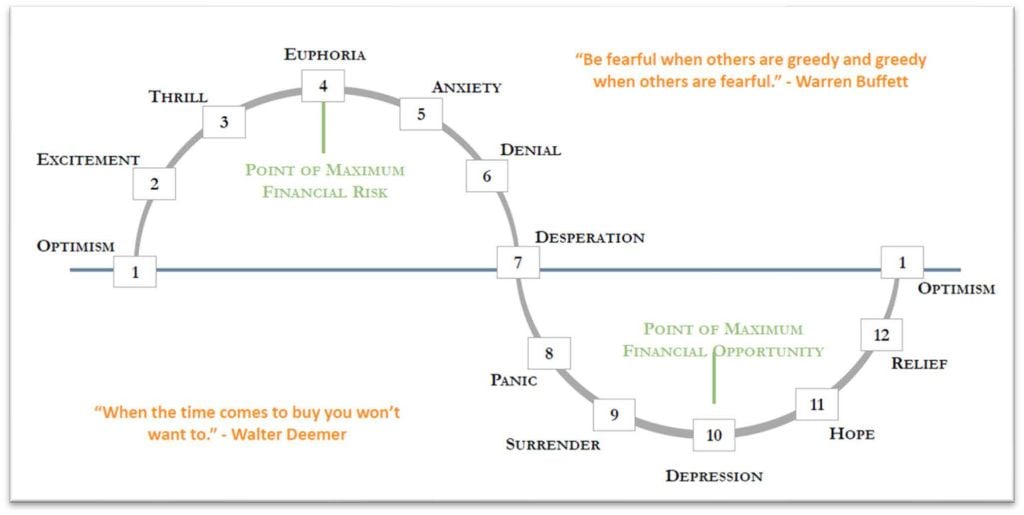
Markets naturally rise and fall and reacting emotionally to these short-term swings can lead to poor timing. Many investors buy when prices are high out of excitement, then sell when prices drop out of fear, which is the exact opposite of a sound investment approach. Sticking to a long-term plan means staying calm during downturns and resisting the urge to chase hot trends during market booms. Emotions like fear, greed, and anxiety can cloud judgment, causing investors to abandon strategies, overreact to headlines, or misjudge risks altogether.
Chasing the latest shiny objects in investing — like trending technologies or hyped sectors — often means buying into assets after much of the upside has already been priced in. This exposes investors to overvaluation risk and sharp corrections if expectations are not met. It can also lead to a reactive, short-term mindset, diverting attention from fundamentals and long-term value. Instead of consistent gains, this strategy often results in buying high and selling low. If a new technology is truly transformative, it will eventually be reflected in the composition of broad-based indexes like the S&P 500. These indexes are designed to adapt and evolve — rising companies gain weight, while declining ones fall away. In other words, patient investors who stick with a diversified index fund can still benefit from innovation, but without the risks of speculative timing or stock picking.
Historically, those who remain disciplined — who stay invested through the highs and lows — tend to perform better than those who frequently jump in and out of the market. Over time, consistency and patience prove far more valuable than attempts to time the market or react to every fluctuation.
[1] This example is provided for illustrative purposes only and is not intended to reflect an actual scenario.
* * *
About the Author
Julien Frazzo is the Deputy Chief Investment Officer of Beacon Pointe Advisors and a member of the Beacon Pointe Investment Committee. Prior to joining Beacon Pointe, Julien served as Director of Equity Research at The Bahnsen Group. Julien is a seasoned investment professional with twenty-four years of experience, including fourteen years as a risk taker in alternative asset management, five years in investment banking, and five years in private wealth management. Julien began his career in the financial industry as an M&A banker and equity research analyst as part of the Lehman Brothers analyst and associate programs. Julien transitioned to the buy-side of the industry in 2004 by joining Citadel as a Senior Analyst before being promoted to Managing Director of Citadel’s Principal Strategy. Julien subsequently served as a Portfolio Manager at several multi-billion-dollar boutique hedge funds before relocating his family to Southern California and transitioning to private wealth management in 2019. Julien earned a Master’s degree in Accounting and Finance and a Postgraduate degree in Corporate Finance, Financial Engineering, and Securities Law from the University of Paris Dauphine in Paris, France. A French native, Julien holds American and British citizenships and lives in Long Beach, California. Having worked in Paris, Amsterdam, London, Chicago, Monaco, and Newport Beach, Julien is a student of many cultures and brings a global understanding of investments to the table.
If you could benefit from a conversation with our advisory team, we would be happy to provide a complimentary consultation.
Important Disclosure: The information contained in this article is for general informational purposes only. Opinions referenced are as of the publication date and may be modified due to changes in the market or economic conditions and may not necessarily come to pass. Forward-looking statements cannot be guaranteed. Past performance is not a guarantee of future results. Beacon Pointe has exercised all reasonable professional care in preparing this information. The information has been obtained from sources we believe to be reliable; however, Beacon Pointe has not independently verified or attested to the accuracy or authenticity of the information. The discussions, outlook, and viewpoints featured are not intended to be investment advice and do not consider specific investment objectives or risk tolerance you may have. All investments involve risks, including the loss of principal. Consult your financial professional for guidance specific to your circumstances. Beacon Pointe provides links for your convenience to other providers’ websites. Beacon Pointe is not responsible for errors or omissions in the material on third-party websites and does not necessarily approve or endorse the information provided.
This document has been prepared with the assistance of Microsoft Copilot, an AI-powered tool designed to enhance productivity and provide support in drafting, editing, and organizing content. Microsoft Copilot leverages advanced AI models to generate text based on user input. Although Copilot generates original content based on user input, there is a risk that the generated text may inadvertently resemble existing works that may not be properly cited. Beacon Pointe Advisors used the AI-powered tool Microsoft Copilot for research, and the content has been fact-checked by the Compliance Department. Because AI is new in nature, there can be no guarantee of its accuracy. No client information was or is permitted to be entered into Microsoft Copilot.